Afternoon
Medication reminders at home in Scottsdale, at the right time of day
A caregiver who prompts at the hour your family and doctor have set, notes what was taken and tells you if a dose is missed or something seems off.
Chapter 01
A reminder is a nudge at the right hour, nothing more
Most people who live alone do not forget their medication because they do not care. They forget because the day has no landmarks left in it. Breakfast ran late, the television was on, the phone rang, and the afternoon pills sat in the organizer until evening. A caregiver in the house changes that without changing who is in charge of the day.
The Hills Premium Services offers medication reminders as exactly that: a person who is there at the time of day the schedule calls for, saying that it is time, bringing a glass of water, and staying while the pills are taken from the person's own organizer. It is a reminder, not dispensing and not administering. Our caregivers do not decide what is taken, change a dose or perform nursing tasks. They help your parent keep to the plan that already exists.
That plan belongs to your family and your doctor. We do not write it and we do not adjust it. If the schedule changes after an appointment, you tell us and the reminders change with it.
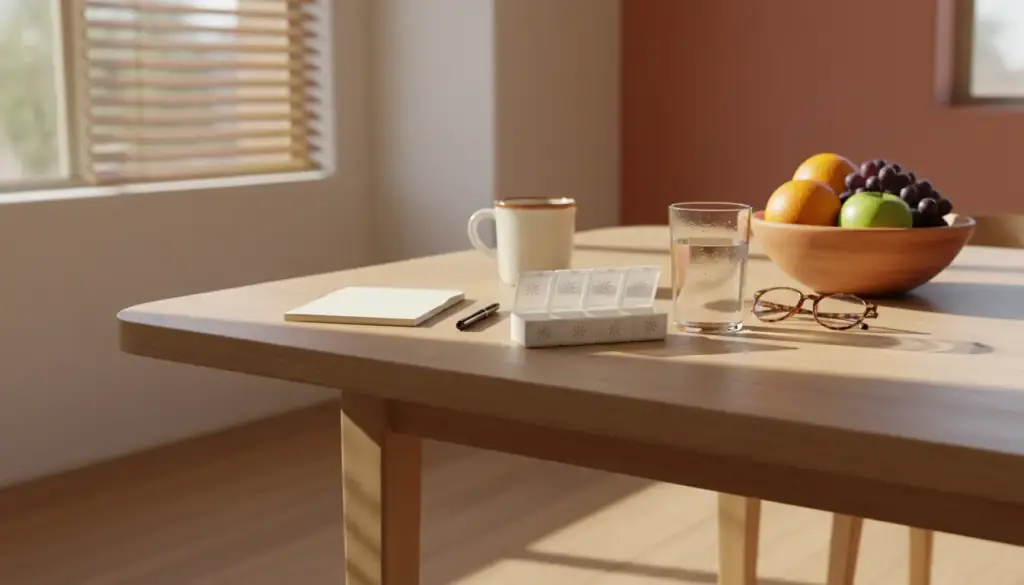
A kitchen table with a weekly pill organizer, a glass of water and reading glasses
Keeping a plain record of what was taken
A reminder only helps the family if someone can say afterward what happened. After each visit the caregiver notes what was taken and at what time, in ordinary words rather than clinical shorthand, so that a daughter in another city or a son at work can see the day at a glance without making a phone call.
This is also useful in the doctor's office. When you are asked whether your mother has been taking the morning tablet regularly, you are answering from a written record instead of a guess. We are not the ones to interpret that record, but we make sure it exists and that it is accurate.
The weekly organizer on the kitchen table stays the center of the routine. We do not ask a family to change systems that already work. If you have a pill box your father has used for years, we use that one.
Chapter 03
When a dose is missed or something seems off
The most important part of a reminder service is what happens when the reminder does not work. If your parent refuses a dose, is not at home when the caregiver arrives, seems more confused than usual, or says they feel unwell, the caregiver tells the family. The point is that the family hears about it, rather than finding out later.
We do not give medical advice and we do not tell anyone whether to skip, double or delay a medication. What a caregiver can do is notice, write it down and make sure the right person hears about it, whether that is you, another relative or the doctor's office that you choose to call.
Families in Scottsdale and north Scottsdale can talk this through with Sarha and her team at the Greenway Parkway office, or call (480) 234-1301 and describe the schedule as it stands today. Medication reminders often sit alongside meal preparation, since a dose taken with breakfast is easier to remember when breakfast is made at the same hour each morning.
The Hills Premium Services, Scottsdale. Call (480) 234-1301.